"True learning and growth come from doing things that challenge you, and from trying things you've never done before."

Cameron Fletcher
- Degree:
- Bachelor of Applied Science
- Program:
- Campus: Vancouver
- Year: 3rd year
There are two things I'm proud of: making it into UBC Engineering and staying in such a demanding program. While spending our time chasing our dreams and aspirations, it is important to remember that survival in a busy and academically rigorous program such as engineering is an accomplishment in and of itself. I have faced many challenges when it comes to learning course material, but I am very proud to be able to say I have persevered through them. In addition, the fascinating course content has made any struggles I had well worth the opportunity to keep learning about science, technology and my place in the world.
Besides academics, I've found fulfillment in the clubs I've joined. I became a member of Sigma Phi Delta (the Engineering fraternity) and found a community of like-minded engineering students who value academics and the full university experience. The camaraderie and guidance from my fellow members have been integral to my success. I've also joined the Varsity Outdoor Club and have gone on many adventures with them. From kayaking the Indian Arm to rock climbing in Squamish, the club helped me explore the natural beauty of BC.
Sigma Phi Delta Varsity Outdoor Club
How did you decide your current UBC Engineering discipline, or why did you choose UBC Engineering?
I chose UBC Engineering for a multitude of reasons. Firstly, its location. I grew up in North Vancouver and wanted to stay local. UBC is far away enough for me to experience living on my own without feeling isolated from my loving family and dog. I also decided to stay in the Lower Mainland because of all the beautiful places I still wanted to explore, like the Indian Arm and downtown Vancouver.

I chose UBC over other BC universities because UBC consistently ranks as one of the top three engineering schools in Canada. Part of this world-class education involves providing a wide variety of engineering disciplines to major in, which was perfect for someone like me who wasn't sure what type of engineering they wanted. In addition, UBC offers a general first year for all engineering students, which was perfect for someone undecided like me.
What has made your time at UBC Engineering memorable?
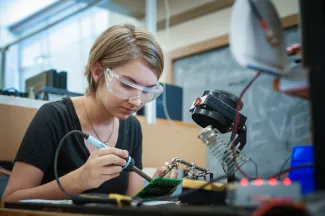
So far, the most memorable course I have taken was the project design course ELEC 291. This was our first real chance to design and build our own circuits in the electrical engineering program. We were introduced to circuit components, applications, and coding our own microcontroller (the brain of the circuit). We then received a task and worked in groups to solve the problem. It was really exciting to figure out how to put together all the pieces of information we had learned so far to construct a working circuit with functional embedded software.
Some of the things we were tasked with designing and building included an alarm clock, an AC voltmeter, a heart rate monitor, and an autonomous coin-collecting robot.
It was a blast working on these projects with my group members. It is very rewarding and satisfying to collaborate with others to accomplish something challenging!
Tell us about your experience in your program. What have you learned that is most valuable?
The most valuable academic experiences I've had are those where I've been confronted with a "brick wall" problem.
I imagine these problems, whether it's a math question, a coding assignment, or a circuit that needs designing, as a massive brick wall that I somehow need to overcome. These problems have no clear solution and, at first, appear unsolvable. My first attempt would be to "smash through" the "brick wall" problem using the lecture slides or methods I have used on previous problems. But this rarely worked.
Through the many "brick wall" problems I have encountered, I learned that mindlessly applying what I've learned isn't enough. To solve the toughest problems, I reflect on how to extend and apply what I learned. Sometimes, different ideas have to be synthesized into new ones, or additional research is required. Whatever the method, I have discovered that the best way to defeat these "brick wall" problems is to come up with your own way around the wall, thinking outside of the box to develop imaginative solutions.

What resources or events organized by UBC Engineering have helped you in your academic, professional or entrepreneurial journey thus far?
One of the biggest ways the UBC Engineering community has helped me academically was through the Engineering Undergraduate Society (EUS) tutoring initiatives. The EUS often releases study guides and problem sheets to assist with difficult course concepts in first year. I'm very grateful knowing that there were upper-year students who cared about my success as a first year. I hope to pass on this favour by volunteering as a EUS tutor this school year. In addition, I found a member in his 3rd year of Electrical Engineering in Sigma Phi Delta (UBC Engineering fraternity) who shared invaluable tips with me to succeed in my second-year courses.
Engineering Undergraduate Society (EUS)
At UBC, we are creating highly impactful solutions that aim to radically transform health and wellness, and shape a society and economy where people are more connected, empowered and effective. How has UBC Engineering inspired your entrepreneurial thinking, and helped you make a difference in your own community or beyond?
UBC has encouraged me to apply what I've learned in my courses by facilitating countless student-run design teams. The opportunity to practice securing funding and sponsorships for student-led design initiatives has been great in encouraging entrepreneurial thinking. The freedom to use my imagination to design technical solutions within these design teams has encouraged me to be more creative in problem-solving.
As for encouraging the well-being of others, I'm delighted that UBC requires us to take courses exploring how our technical decisions impact the environment and society as a whole. These courses encourage engineering students to be more nuanced and holistic in their technical decisions. I'm glad to have been taught that the best solution to an engineering problem is one that goes beyond science or economics. The ideal solution takes nature and the well-being of all people into account as well.