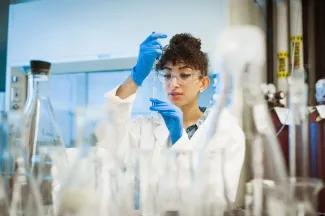
"Failure gave me insight into the ways people work, how to be an effective leader, and ultimately how to increase my probability of success."
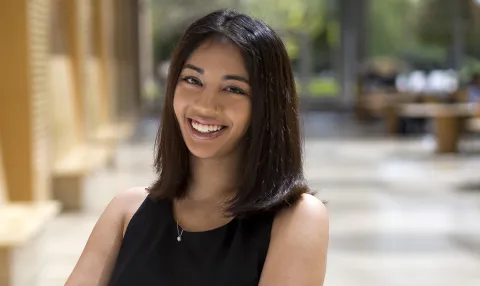
Ashna Misra
- Degree:
- Bachelor of Applied Science
- Grad year: 2019
- Program:
- Campus: Vancouver
Ashna has always been someone with a little bit of “artistic chaos.” In the last five years, she has been an entrepreneur, an educator and a leader. In her second year, she co-founded Grounders Magazine which features new artists in a variety of mediums across the country. This project was coupled with a series of events in Toronto and Vancouver along with exclusive online interviews. Shortly after, Ashna began working with the Melt Collective to create a space for students to repurpose plastic waste on campus. This experience introduced her to the world of mismanaged waste and its potential in a circular economy. During her final year, she co-created APSC-498T, a course on decarbonization technology and policy, to teach engineers a multidisciplinary and systematic approach to climate change problems.
Her interest in sustainability has stemmed into a life-long mission of education on decarbonization pathways and its intersections with technology and policy.

What has made your time at UBC the most memorable?
The opportunity to experiment.
I spent every year trying new things and facing failure. Failure gave me insight into the ways people work, how to be an effective leader, and ultimately how to increase my probability of success. UBC is extraordinarily dense with people learning and creating. I am incredibly grateful for the growing experiences with these people, whether it was finding a space to melt plastic, learning how to market a magazine, or designing a course. University is a playground for ideas, with more mentors and financial support than anywhere else, and a much lower barrier for access. This is your chance to experiment with something you have never tried before!
What have you learned in engineering that is most valuable?
Engineering taught me to push myself. During my first two years, I struggled because I felt a disconnect between the content I was learning and my hands-on expectations for engineering. I realized I had to take initiative to create the university experience I wanted. In these years, I founded Grounders Magazine, worked as a Vancouver Summer Program coordinator, and joined the Melt Collective engineering student team.

Through extracurricular activities I met incredibly driven people who enjoyed their studies and actively sought ways to apply them.
Inspired, I refocused on the parts of my academic experiences that I enjoyed. These were my philosophy courses and sustainability-based courses. In my final year I decided to pursue these by working towards a philosophy minor and co-creating a student directed seminar on decarbonization technology and policies. The logistics of this commitment meant I was taking nine courses in my final semester. It was a push, a full immersion in academics, but it was also incredibly rewarding.
Learning how to take initiative, manage my time and push myself are skills I will bring beyond engineering into all aspects of my life.
What advice would you give a student considering engineering?
It is incredibly important to know what you are committing to. I did not have a clear idea of what chemical engineering was and I struggled with the content because I did not feel attached to it. That said, any degree will always have elements of inertia on the student’s part. During those points you should think of the larger context of information and encourage yourself to spend even more time understanding the things you may have a natural dislike for.
Go out and engage with things outside of pure academia.
Join an engineering student team, go to seminars in different faculties, volunteer at a waste audit; activities outside of school create context and build holistic applications for your studies.

What are your plans for the future?
In the short term I plan to do technical work and get a practical understanding of the theory I have learned. Somewhere in the next decade I hope to return to school for a master’s degree. I am very interested in policy and the way it interacts with communities. Long term, I hope to work on sustainable policies for waste and energy on a local or national scale. In addition, I plan to modify APSC-498T into a community initiative for locals interested in learning more about decarbonization, or other systematic problems, to share ideas and discuss readings.