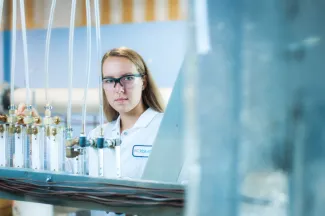
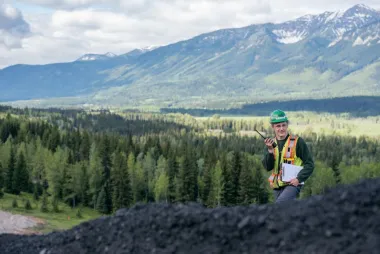
"Engineering is a field that benefits immensely from a diversity of people solving problems, and it’s important to introduce engineering as an opportunity early and often."

Katherine Westerlund
- Degree: Bachelor of Applied Science
- Grad year: 2020
- Program:
- Campus: Vancouver
Katherine Westerlund is a 2020 graduate with a BASc in Geological Engineering. She has interests in rock mechanics, numerical modelling and groundwater modelling. In her spare time, she enjoys running, hiking and everything coffee. After UBC, she will be working as a Tunnelling EIT at Mott Macdonald.
She served as an Engineering Undergraduate Society executive for three years as the VP Admin, VP Finance and stepping up to the role of Interim President during her last term at the university. Throughout her tenure at the EUS, she dramatically expanded their awards program by introducing awards for program club and design team involvement. The EUS was awarded Constituency of the Year during her presidency.
During her last year at UBC, she also served as one of two Engineering representatives on the UBC Alma Mater Society's Board of Governors. She was appointed chair of the AMS' Governance Committee and served as a councillor on several other committees. She was awarded Councillor of the Year in 2020.
She was also involved in the design team community itself. In her first year she joined the UBC Concrete Canoe team working on their concrete mix design sub-team. Later in her degree she joined SUBC, working as both their treasurer and Hull team lead.
Why did you choose to go into your field of study at UBC?
I think of geological engineering as the type of engineering that deals with the interaction between the built world and the natural world. I had interests in environmental engineering and civil engineering, and once I learned more about what geological engineering is the more it seemed like the right degree for me. I was interested in the scale of problems you end up working on (earth dams are some of the largest structures in the world) and having the ability to work both in big cities and the middle of nowhere doing field work.
I was really drawn to the uncertainty that is associated with every geological engineering project. The Earth is really complicated and the processes that have formed our current earth have taken billions of years to occur. We've only really been paying attention to them for a couple hundred years at best, which means there's still so much to contribute to the field of Geological Engineering.
What has made your time at UBC memorable?
This is probably a cliché for engineering students, but my Capstone project was one of the most memorable things I did at UBC. Our group of 4 people managed to take on a project of relatively large scope, successfully navigate our way through endless decisions and revisions and not murder each other in the process.
Our project was the pre-feasibility assessment of a water conveyance tunnel in Norway. Our project scope was relatively large, with many more engineering design elements than any of us initially considered when selecting the project. I had limited experience working on a project of this magnitude before Capstone, so it taught me a lot about all the different considerations that go into a large-scale engineering project. It also taught me a lot about what to do when you don't know something. There were many instances throughout the project when we would reach an impasse and not know how to proceed. Fortunately, our sponsors were very thoughtful in showing us the process of how to solve problems like these (even though it was more complicated than just giving us the right answer).
What has been your most valuable non-academic experience studying at UBC?
As previously mentioned, I was very involved on campus. I'd say the activity that taught me the most was my time with the Engineering Undergraduate Society. I learned a ton from my work there that has developed me as a person and made me a better (future) engineer. I've become very good at making consequential decisions under pressure, taking control of a situation to steer it in a positive direction and juggling like 10 different high-stakes tasks at once. The work was hard and at times it definitely showed me my absolute limit as to what I can handle as a human being, but it also showed me just how much impact I could have on the lives of the people around me. I organized countless events, gave out over a million dollars in PAF funding — I truly hope I left the Society better than I found it.
The culmination of my involvement was the iron ring advocacy at the end of my final year. After inappropriate comments made at an information session about the iron ring, I made it my mission to replace the presenters at the ceremony and inspire systematic change within the Camp. It's a bittersweet story, because just as we were successful in getting the national organization to intervene and host the ceremony themselves the entire thing was cancelled because of COVID-19. It was one of our greatest achievements over the last couple years, and while it almost broke me, I am so honored to have had the opportunity to fight for the changes ahead.
Tell us about your experience in your program. What have you learned that is most valuable?
Geological Engineering follows a more inductive reasoning path than other engineering degrees, in which you abstract small specific details about a site into more general trends that assist you in your decision making. Having a good idea about what your final model needs to look like and contain in order to assist your decision making is critical. This means my degree has given me a much better grasp on the effects of uncertainty on a project and identifying unknown and important variables. In many projects, it costs a lot of money or is extremely difficult to acquire more information about a project site (imagine how expensive it is to drill boreholes to collect samples from directly underneath Broadway, or from a mountain several hundred kilometers from any road), so you need to prioritize the information you’re collecting to best assist decision making. It becomes your job as the engineer to piece together all the different small hints you’ve collected to get a view of the larger site characteristics so you can make major calls about the future of whatever project you’re working on. Sometimes you don’t have information about something, but if it isn’t going to change your conclusions then it’s just adding complexity without substance. My degree has taught me to discern what is and isn’t useful information for decision making.
How are you applying the skills you learned through your studies at UBC?
As surprising as it may sound, people don’t ask me to design earthfill dams or identify the mineralogical content of a hand sample every day. Fortunately, my degree has made me quite good at solving problems efficiently. This has come in handy in a number of situations throughout my life, including the construction of Ikea furniture or fixing several major appliances around my aging rental house.
What advice would you give a student entering your degree program?
There will be a lot of pressure, often self-imposed, for you to be absolutely perfect in everything you do here. You will think that you are a failure when you extend your degree beyond four years, and you need to know that is absolutely not true. UBC is full of wonderful opportunities for involvement and development, and you will become a different, stronger and better engineer for getting involved. Engineering is about so much more than just getting through the courses, and once you stop beating yourself up to try and do everything at you’ll be happier, healthier, think clearer and learn so much more both within and outside your classes. There is value in activities outside of a traditional geological engineering degree, like designing a human powered submarine or a floating canoe made out of concrete or eventually being in charge of the entire Engineering Undergraduate Society, and you’ll be a much better engineer and person for getting involved with them.
How do you feel your degree has benefitted you compared to a different field of study?
I firmly believe an engineering degree is one of the craziest, best things you could ever do. When you get a degree in engineering, your entire perspective on the world shifts. Don’t get me wrong, you learn a lot of facts while in an engineering degree program, but you also learn how to solve problems, big and small. You learn how to think critically better than many other degree programs out there. You also learn about responsibility and ethics. As a professional engineer, you must hold the safety of the public and the environment at the forefront of all your decisions. You have a lot of power and trust placed in you. It’s a unique combination of difficult technical knowledge, critical problem-solving skills and the mission to improve the lives and communities of the people you serve. I am a completely different person than who I was at the beginning of my degree. I consider problems differently, communicate more effectively and have a different view of how the world works. There are a lot of problems in the world today, and there are a lot of current and future engineers that will solve them.
Where do you find your inspiration?
I found my inspiration from my fellow classmates at UBC. One of the great things about our school is there are seemingly infinite ways to spend your time on non-class activities. There are so many people balancing inspirational feats with their course load. All the folks on design teams building autonomous sailboats, actual cars, rocket engines or canoes made out of concrete for some ungodly reason. All the folks building communities through other on-campus groups like Women in Engineering, .caISES, Engineers without Borders, Gears and Queers and many others. Folks involved with their program clubs, or even the EUS, whose passion comes out in the strangest ways during E-Week. All the folks involved with initiatives outside of engineering. All the folks balancing an engineering course load with a part- or full-time job. There are so many people on this campus working so hard, and it was incredibly inspirational to keep myself working as hard as I could to do my absolute best for all of them.
What are your immediate and/or long-term plans for the future?
I am fortunate enough to be working with Mott Macdonald as a Tunnelling EIT in their Vancouver office. I’ll be starting work remotely in June, which should prove to be a strange experience. Tunnelling is a field I’ve been interested in for a while, starting in second year when I participated in the UBC geotechnical engineering competition. I then took several rock mechanics courses and was part of the tunnel design capstone team so I’m pretty excited to actually get to work in tunnel engineering.
In non-work activities, I’m training for a half marathon later this summer and am planning a scuba diving trip for after the global pandemic is resolved. I’d also imagine we will have Iron Ring and graduation ceremonies in the future, although the cynic in me thinks that will happen later rather than sooner.
What are your future plans to make a difference in our world?
Short term, I’m still advocating to Camp 5 and the Corporation of the Seven Wardens to ensure an inclusive and celebratory Iron Ring ceremony for all future UBC Engineering graduates. It’s something I was working on during my final year at UBC, and something that I intend to see through my own Iron Ring ceremony and beyond.
When the pandemic is over, I’d like to work with the Girl Guides of Canada to develop new programming for STEM education. I was a girl guide for 11 years, and I’d love to give back to the community that taught me so much. Engineering is a field that benefits immensely from a diversity of people solving problems, and it’s important to introduce engineering as an opportunity early and often.