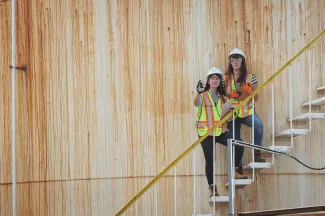
"Even though being able to problem-solve is important, I think that the most valuable skill an engineer can have is the ability to listen and communicate."
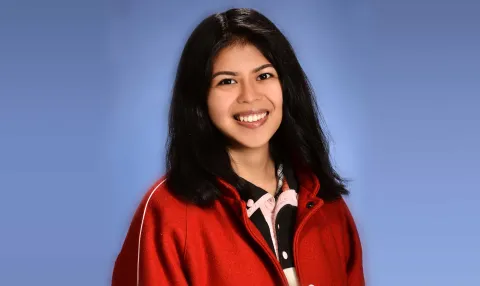
Julia Dinglasan
- Degree:
- Bachelor of Applied Science
- Grad year: 2020
- Program:
- Campus: Vancouver
After spending my first year in the UBC Faculty of Science, I transferred into engineering. During my first year in engineering, I didn’t make an effort to get involved in the engineering community — I already had friends from first year residence, I figured the engineering workload was enough and I felt what can best be described as imposter syndrome. As a first-generation woman of color transferring into engineering, I felt pressure to succeed academically. At the end of the year, I looked around in my class of 200 students and realized that I didn’t really know anyone.
After this realization, I made the decision to get involved. Since then I’ve held positions in various groups, including UBC Civil Engineering Club (President 19-20, VP Student Life 18-19/17-18), UBC Engineering Undergraduate Society (Councillor/Committee Member 19-20, 14 Not Forgotten Manager 17-18, Sustainability Representative 17-18), UBC Women in Engineering (committee member 18-19), and UBC Concrete Toboggan (member 17-18).
I met wonderful people, made so many fond memories as a result and realized that finding a community in engineering actually helped my academics.
I also realized that I could leverage my role as a student leader in civil engineering to create an inclusive environment to uplift and celebrate people of all backgrounds through culture-building and event-planning.
Civil Engineering Club Engineering Undergraduate Society Women in Engineering Concrete Toboggan
What has made your time at UBC memorable?
I’m from California, so having the opportunity to live for 5 years in a new city/country was definitely a memorable experience. I will always keep the relationships I fostered during my time in Vancouver close to my heart. Vancouver is a beautiful city and I am forever impressed by the crystal-clear water, the proud mountains, the cherry blossoms in the spring, the ridiculously robust food scene and the buses that say “SORRY.”


Tell us about your experience in your program. What have you learned that is most valuable?
Going into engineering, I thought that being good math would be the most important skill in the engineers' metaphorical toolbox. As I've spent more time in the program, I've realized that even though being able to problem-solve is important, I think that the most valuable skill an engineer can have is the ability to listen and communicate. Civil engineers design the built environment and help manage the natural environment. This gives us a lot of power. This power should be used to uplift communities; however, as with all kinds of power, this can potentially be abused. Engineers are supposed to serve the public interest, and this can only be done by properly listening and communicating with stakeholders--and to be earnest, honest and open-minded while doing so. Being good at listening and communicating will make it easy to convey information to clients, coworkers, subcontractors and all other professional relationships within the field.
The skills you need to succeed as an engineer
What advice would you give a student entering your degree program?
Find things outside of engineering that make you happy!
Your entire university experience doesn’t necessarily need to revolve around just engineering. Maybe your thing is hitting the gym or hanging out with friends or educating yourself on social justice issues or learning how to ferment various vegetables. Whatever your thing is, it’s nice to have something to turn to if you ever want a break from engineering.

How do you feel your degree has benefitted you compared to a different field of study?
Engineering straddles the line between science and art — it uses science concepts to make art a reality. I think that being in engineering has made me appreciate both subjects even more.
What are your future plans to make a difference in our world?
Civil engineers have a ton of potential to shape the world around us in ways that can simultaneously improve the environment and champion historically marginalized communities.
The possibilities range from providing remote communities clean and reliable water to designing equitable transportation systems and creating sustainable buildings and cities. Right now, I’m compiling a list of resources that touch on the intersection between social justice issues and civil engineering. This list includes podcasts, videos, articles, books — you name it. The goal is to start an industry-wide conversation on the civil engineer’s roles in the context of broader social issues.

How has your identity informed your academic and professional experiences within your field at UBC and beyond?
I am proud to be a woman of color — a Filipina woman to be exact. My experience as a visible minority in engineering has informed me in many ways. I believe it has made me more receptive and empathetic to other marginalized voices. This ability to seek out and listen to other people’s perspectives enhances my ability to communicate, which in turn helps me be a better engineer.
Although my identity lies at the intersection of different forms of oppression, there are many ways that I am privileged — for example, I come from a middle class upbringing, I have the opportunity to obtain higher education, I benefit from the model minority myth, etc. I am trying to better recognize the ways in which my privileges inform my experiences. I've made some progress, but there's still a whole lot more to understand. I'm looking forward to learning more about it!