With a long‑standing interest in aerospace and applied physics, Arturo Oropeza came to UBC determined to build a career in aviation. Today, he’s a methods engineer at De Havilland Canada, helping transform complex aircraft designs into precise, buildable processes on the manufacturing floor.

Arturo Hasfield Oropeza
- Degree:
- Bachelor of Applied Science
- Grad year: 2022
- Program:
- Campus: Vancouver
Tell us about your work as a methods engineer at De Havilland.
De Havilland’s facility in Victoria builds parts for several of its aircraft programs, including the Twin Otter, the Dash 8 and its flagship firefighting aircraft. We also provide maintenance, repair and overhaul services from this location.
As a methods engineer, I am the bridge between manufacturing and design.
I work closely with the team on the floor – the people physically building the aircraft – to provide real-time technical support, solve problems and answer questions about the manufacturing process. More specifically, I am an assembly methods engineer, which means I focus on sub assemblies for the aircraft, such as parts of the wing, cockpit, fuselage and electrical components.

If there’s a conflict between the design and what can be achieved in the manufacturing process, I work with the design engineers to suggest and implement changes. I also research and implement new processes to make improvements in terms of weight, cost or performance.
Design engineers define the outcome – such as the specifications of a certain part, with its dimensions, curve and shape. Methods engineers determine the process by which that design can be achieved, creating the set of instructions for the operators to manufacture or assemble the part.
In some cases, this involves acquiring new machinery or adjusting parameters on existing equipment. We also design and conduct testing to ensure that the final part of the assembly meets the design requirements.
What aspects of your job do you find particularly rewarding?
When I first began working at De Havilland I was a quality engineer, with a scope of work focused on finding non-conforming parts and reporting. In my current role, which I’ve held since August 2025, I have more decision-making power. I can explore processes that might be more efficient or can save time for our operators, and I have more impact in the way that we manufacture parts.

It’s exciting to be part of a company that manufactures some of the world’s best firefighting aircraft and is constantly working to improve the design to make them more powerful and user friendly for pilots. We have seen the devastation caused by wildfires here in Canada and around the world. With the federal government’s push to build manufacturing capacity, there is significant potential for the industry to keep growing and innovating.
You are originally from Mexico. Why did you choose to do your engineering degree at UBC?
From a young age, I knew I wanted to travel and explore the world. When a representative from UBC spoke at my high school, I got interested in learning more about the city, the campus and its programs. I knew I wanted to study something related to aerospace engineering, and mechanical engineering became a way for me to do that.
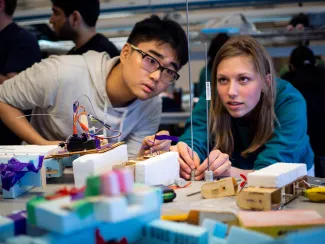
The courses that stand out for me are those where we had to design and make a product.
It’s one thing to design something on paper or on the computer, but it’s when you are actually making something in real life that the challenges emerge and you need to start solving a whole new set of problems. These projects also really highlight the integrated nature of design and manufacturing.

Do you think UBC prepared you for your career, both in terms of technical and soft skills?
Definitely. It’s interesting how things that were mentioned in school – like communication, relationship and organizational skills – now resonate much more with me and I realize their true importance.
Engineering is all about communication and teamwork and you are only as effective as your ability to communicate.
If I have a great idea but cannot explain it to my leadership team, it’s very unlikely that my great idea will come to life. At UBC, you learn soft skills through projects and working in teams, which equips you to learn how to align a team on a goal, keep people motivated and come to agreement with people with different viewpoints. You also learn how to deal with uneven workloads, resolve disagreements and communicate clearly — all of which are essential in industry.

Any advice for students considering engineering?
Get exposure to different areas. Talk to people that are working in an area of engineering you are interested in and get a sense of what their daily life is like and what career paths are open to them. Understanding what a job actually involves can help you make a more informed decision and avoid regret later on.
I also wish I had joined a design team – they provide great exposure to real-life scenarios and enable you to apply what you are learning.