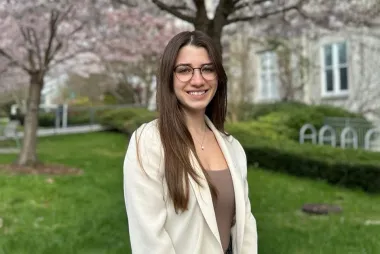
As a field engineer at the Vancouver Airport Authority, Jessica Chan supports the airport terminal projects team on construction and maintenance projects. Prior to this role, Jessica was an environmental technician at the airport, receiving the national Canadian Airports Council’s Rising Star Award in 2026 for her contributions to responsible stewardship and land and water use practices in the aviation sector.

Jessica Chan
- Degree:
- Bachelor of Applied Science
- Grad year: 2019
- Program:
- Campus: Vancouver
Tell us about your first job at the Vancouver Airport Authority.
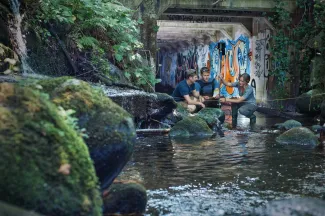
I joined the Vancouver Airport Authority’s Climate and Environment team in early 2022, working in a range of areas, including the water quality management program, spill response, hazardous waste management and environmental compliance. A major area of focus involved monitoring water quality during winter operations when aircraft are de-iced, and finding ways to prevent and mitigate glycol loss to the environment.
My work also included sampling and tracking emerging contaminants such as 6PPD‑quinone and PFAS and supporting incident command during spill response events. These responsibilities required me to identify issues and make data- and science-informed decisions about how to maintain infrastructure to minimize impacts and prevent environmental degradation.
One of the most rewarding elements of this position was becoming a subject matter expert for the airport when working alongside our partners, like de-icing service providers and ground handlers, and providing the guidance and recommendations they need to do their jobs safely responsibly
And what are you doing now?
After four years as an environmental technician, I was ready for a pivot – both to broaden my skill set and develop the competencies required to qualify for my professional engineering designation. I felt that I had rounded out my skills in my previous role and was ready for different and new challenges.
Since the spring of 2026 I have been working as a Field Engineer for Airport Terminal Projects.
This position requires a different skill set than my previous position, and it involves supporting the delivery of terminal construction projects, which can include everything from roof replacements and bag hall upgrades to HVAC upgrades and bridge replacements.

My role includes tracking deficiencies, monitoring construction progress, conducting site inspections, managing contracts, and coordinating with our operations team to ensure that construction and maintenance activities do not interfere with airport operations.
It’s a very results-oriented position.
Our team is focused on making the airport better, whether that’s through improved heating and cooling functions that contribute to our Net Zero by 2030 goal or extending the lifespan of critical infrastructure.
Looking back, what led you to engineering?
My original interests were always environmental in nature, and I saw engineering as a funnel to making tangible, positive change. I was drawn to the idea of results-based work where you can see physical, visible outcomes. I pursued the joint UBC/UNBC Environmental Engineering program, completing my first two years in Prince George at UNBC and the remainder at the UBC Vancouver campus.
UBC/UNBC Environmental Engineering program

Any highlights from your time at UBC?
Starting my program at the UNBC campus was an intentional decision. I grew up in Richmond and wanted to experience a different community. Taking those foundational courses in calculus, physics and environmental science with a small cohort was very positive and I appreciated the ability to get to know my professors and classmates.
After two years I was excited to come to UBC Vancouver and experience a larger, lively campus with its diverse opportunities.
Despite the scale, I found that academic support remained strong, especially in upper‑level technical electives, where smaller class sizes and specialized content helped me explore new areas.

Co-op was also a highlight. I worked in environmental regulation for the oil and gas and industrial manufacturing sectors in Alberta, as well as a term with an environmental consulting company in Vancouver.
Co-op helped me understand the many career opportunities within my field and the nuances of working with interdisciplinary professionals.
What excites you for the future of the industry and the kind of work you are doing?
The work we do as engineers is very dependent on the nature of the industry and the broader geopolitical atmosphere. In the aviation sector, we’re entering a period of significant change, and engineers will continue to play an important role in managing infrastructure, critical decision-making, and ensuring airports can support the movement of people, cargo and talent.
Any advice for students considering engineering?
Be very intentional about what you are learning.
Don’t just learn to get the grades – learn to learn. There is real joy and satisfaction that comes when you put in the time to finally understand a proof or theory. Your professors and TAs are invaluable resources for helping you get the most out of your degree; rely on them to be the academic mentors they are meant to be.
Also, even in your first year, start thinking about what you might want to do after graduation and the opportunities that exist.
Explore different pathways through technical electives, co-op positions or even by browsing LinkedIn to understand what engineering professionals are doing in the workforce and finding your interests. There may be more opportunities out there than you can imagine!